Table of content

Use this Subtracting fractions calculator to subtract proper fractions, improper fractions, and mixed numbers. Enter two values, choose the output style, and get a clean result plus optional steps. It also works as a quick fraction subtraction calculator for schoolwork and everyday math.
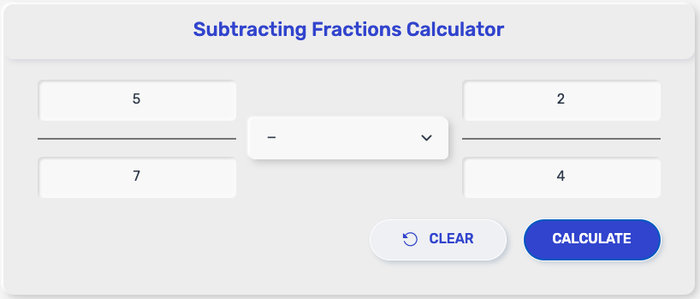
Using this fraction subtraction calculator takes a few seconds. Enter your numbers, pick the format you want, and the tool returns the final difference right away—clean and ready to copy.
Type the first fraction (your starting value). You can enter a proper fraction (like 3/4), an improper fraction (like 9/5), or a mixed number (like 2 1/3).
Type the fraction you want to subtract (the amount taken away). The calculator accepts the same formats, including negative values if needed.
Choose an output style based on what you want to show: simplified fraction, mixed number, or decimal.
Click Calculate to run the subtraction and simplify the result.
Copy your answer.
This workflow also fits a quick subtraction calculator for fractions when you’re checking homework, recipes, or measurements.
This Subtracting fractions calculator covers the common formats you’ll see in class and real-life calculations, without extra setup.
Proper fraction − proper fraction
Subtract two fractions that are already less than 1 (like 5/8 − 1/8 or 3/4 − 2/3).
Improper fraction subtraction (including negative results)
Works with top-heavy fractions (like 11/6 − 7/3). If the second value is larger, the fraction subtraction calculator still returns the correct negative answer.
Mixed number subtraction (with borrowing when needed)
Handles mixed numbers such as 4 1/5 − 2 3/5. When the fractional part of the first number is smaller, the tool borrows from the whole number automatically.
Unlike denominators (automatic common denominator)
For problems like 2/3 − 1/4, the subtraction calculator for fractions finds a common denominator behind the scenes so you don’t have to.
Simplified answer (lowest terms)
Results are reduced to the simplest form whenever possible, so you don’t end up with something like 6/8 instead of 3/4.
Optional outputs: mixed number, decimal, step-by-step working
Switch the display depending on what you need—keep it as a simplified fraction, convert to a mixed number, or view a decimal version. If your tool offers steps, it can show the conversion and simplification process.
Practice mode (subtracting fractions generator)
If enabled, the subtracting fractions generator can create random subtraction problems (same denominators, unlike denominators, mixed numbers) so you can practice and check answers instantly.
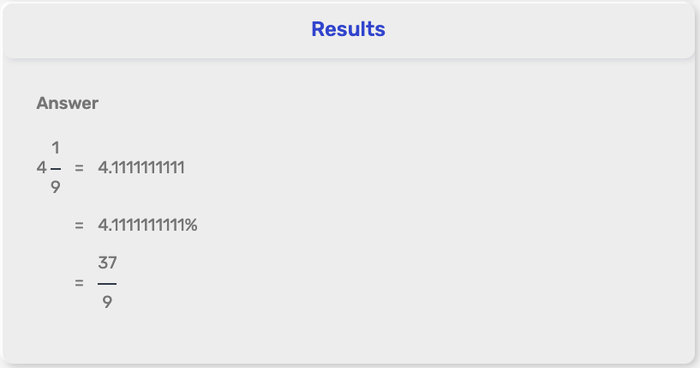
Once you hit Calculate, the subtracting fractions calculator may show a few lines. Here’s what you’re looking at:
Final answer
This is the finished difference after subtracting the second value from the first. Depending on your settings, it may appear as a fraction, a mixed number, or a decimal.
Simplified fraction
The same result, reduced to lowest terms. If the answer can be simplified (like 6/8 → 3/4), the fraction subtraction calculator shows the cleaner version here.
Mixed number (optional)
If the result is an improper fraction (top-heavy), the tool can also show it as a mixed number (for example, 7/3 → 2 1/3). This is useful when your worksheet or teacher prefers mixed-number form.
Common denominator (if shown)
When the fractions have different denominators, the subtraction calculator for fractions may display the shared denominator it used to subtract accurately. You’ll usually see the converted equivalent fractions right before the final result.
Step-by-step (optional)
A short breakdown of the same work: finding a common denominator, converting each fraction, subtracting the numerators, then simplifying. It’s formatted so you can copy it into homework neatly.
Behind the scenes, the calculator follows standard fraction subtraction rules and checks simplification, so the output stays consistent and clean without extra manual steps.
Even if you’re comfortable with fraction subtraction, a few small slip-ups can throw off the result. A Subtracting fractions calculator is handy for spotting them instantly.
Subtracting denominators directly
A super common mistake is doing something like (a/b − c/d) = (a−c)/(b−d). Denominators don’t work that way—your fraction subtraction calculator keeps the denominator logic correct.
Skipping the mixed-number conversion
Mixed numbers need to be converted (or handled carefully) before subtracting. If you jump straight into subtraction without converting, the answer often goes off. The subtraction calculator for fractions handles the conversion automatically.
Sign mistakes when the second fraction is larger
If you do 1/4 − 3/4, the answer is negative. Many people accidentally flip it to a positive value. This subtracting fractions calculator returns the correct sign every time.
Forgetting to simplify the final fraction
Getting 10/20 instead of 1/2 is technically the same value, but it’s not the final form most teachers expect. The calculator reduces results to lowest terms.
Borrowing errors with mixed numbers
Problems like 2 1/4 − 1 3/4 require borrowing 1 from the whole number (turning it into 1 5/4 − 1 3/4). The tool avoids the common borrowing misstep and shows the correct simplified result.
If you want to see what the calculator is doing in the background, fraction subtraction always follows the same structure: get both fractions on the same denominator, subtract the numerators, then simplify the final result. This is exactly what a fraction subtraction calculator automates—especially when the denominators don’t match.
You’re subtracting:
First fraction: a/b
Second fraction: c/d
So the expression is: a/b − c/d
Fractions can only be subtracted cleanly when they share the same denominator. A subtraction calculator for fractions typically uses b × d (or an LCD if it’s showing the most efficient path), then rewrites both fractions into equivalent forms.
To line up denominators, multiply:
a/b becomes (a × d) / (b × d)
c/d becomes (c × b) / (d × b)
Now both denominators match.
Once denominators match, you subtract only the top numbers:
a⁄b − c⁄d = (ad − bc)⁄bd
That single line is the core rule behind most fraction subtraction steps.
After subtraction, the answer may be reducible. The calculator reduces it by dividing the numerator and denominator by their greatest common factor (GCF). For example, 6/8 becomes 3/4.
If the final fraction is improper (numerator larger than denominator), many tools also show a mixed number version. For instance, 7/3 can be shown as 2 1/3. This is optional, but it’s common in worksheets.
If you subtract mixed numbers like 2 1/4 − 1 3/4, the tool usually converts them into improper fractions first (or borrows when needed), then applies the same rule above. That’s why a subtracting fractions calculator is also useful for checking borrowing steps without guessing.
This section is also a nice fit as a collapsible “Math used” area under your tool, since it explains the logic without turning the page into a full lesson.
OpenStax (2020) – Prealgebra 2e, Section 4.5: Add and Subtract Fractions with Different Denominators
https://openstax.org/books/prealgebra-2e/pages/4-5-add-and-subtract-fractions-with-different-denominators
OpenStax (2020) – Prealgebra 2e, Section 4.6: Add and Subtract Mixed Numbers
https://openstax.org/books/prealgebra-2e/pages/4-6-add-and-subtract-mixed-numbers
OpenStax (2020) – Prealgebra 2e, Section 4.4: Add and Subtract Fractions with Common Denominators
https://openstax.org/books/prealgebra-2e/pages/4-4-add-and-subtract-fractions-with-common-denominators
Khan Academy (n.d.) – Add and subtract fractions (different denominators)
https://www.khanacademy.org/math/arithmetic/x18ca194a%3Aadd-and-subtract-fractions-different-denominators
Math Is Fun (n.d.) – Subtracting Fractions
https://www.mathsisfun.com/fractions_subtraction.html
Purplemath (n.d.) – Adding and Subtracting Fractions (common denominators + unlike denominators approach)
https://www.purplemath.com/modules/graphing/fraction4.htm
Make the denominators match first (using a common denominator), then subtract the numerators and simplify. A fraction subtraction calculator does this automatically, so you don’t have to find the common denominator by hand.
Yes. Enter mixed numbers like 2 1/3 and 1 5/6. The subtraction calculator for fractions converts them behind the scenes and returns the result as a simplified fraction or mixed number (based on your settings).
In most cases, yes. The tool reduces the final fraction to lowest terms so you don’t end with something like 10/20 instead of 1/2.
That’s normal when the second fraction is larger than the first (example: 1/4 − 3/4). The Subtracting fractions calculator keeps the correct sign and shows the negative result clearly.
Yes, if the tool has an output toggle. Many versions of a fraction subtraction calculator let you display results as a mixed number when the numerator is larger than the denominator.
Yes. Enter values like 11/6 − 7/3 and the subtraction calculator for fractions will subtract, simplify, and optionally convert the result.
It might be the same value written in a different form—like an improper fraction vs a mixed number, or a simplified fraction vs an equivalent fraction. Try switching the output format to match what your worksheet expects.
Subtractingfractionscalculator.com is a simple online tool designed to help students, teachers, and anyone working with fractions quickly subtract fractions with accuracy and ease. By entering the fractions you want to subtract, the calculator instantly provides the correct result along with clear steps, making fraction subtraction easier to understand and apply.
This tool is especially useful for learning, homework, classroom practice, and quick calculations without needing manual fraction conversion or complex math steps.
Subtractingfractionscalculator.com was created as part of a collection of lightweight online calculators focused on making everyday math simpler and more accessible on the web.
This tool was developed and maintained by a small team of independent developers and contributors dedicated to building practical, easy-to-use online calculation tools for students, educators, and everyday users.
We are committed to providing transparent, reliable tools while respecting user privacy.
The Fraction Subtraction Calculator does not require account registration and does not collect or store personal information. Any numbers entered into the calculator are used only to perform the calculation and are not saved or shared.
This calculator uses standard mathematical methods to subtract fractions and simplify results. While we strive for accuracy, the results are intended for informational and educational purposes only. Users should verify results when applying them in important academic or professional contexts.
By using this tool, you agree to use it responsibly. The developers and contributors are not liable for any decisions or outcomes based solely on the results generated by this calculator.
We may update this policy from time to time to reflect improvements to the tool or changes in our practices. Any updates will be posted on this page to maintain transparency.